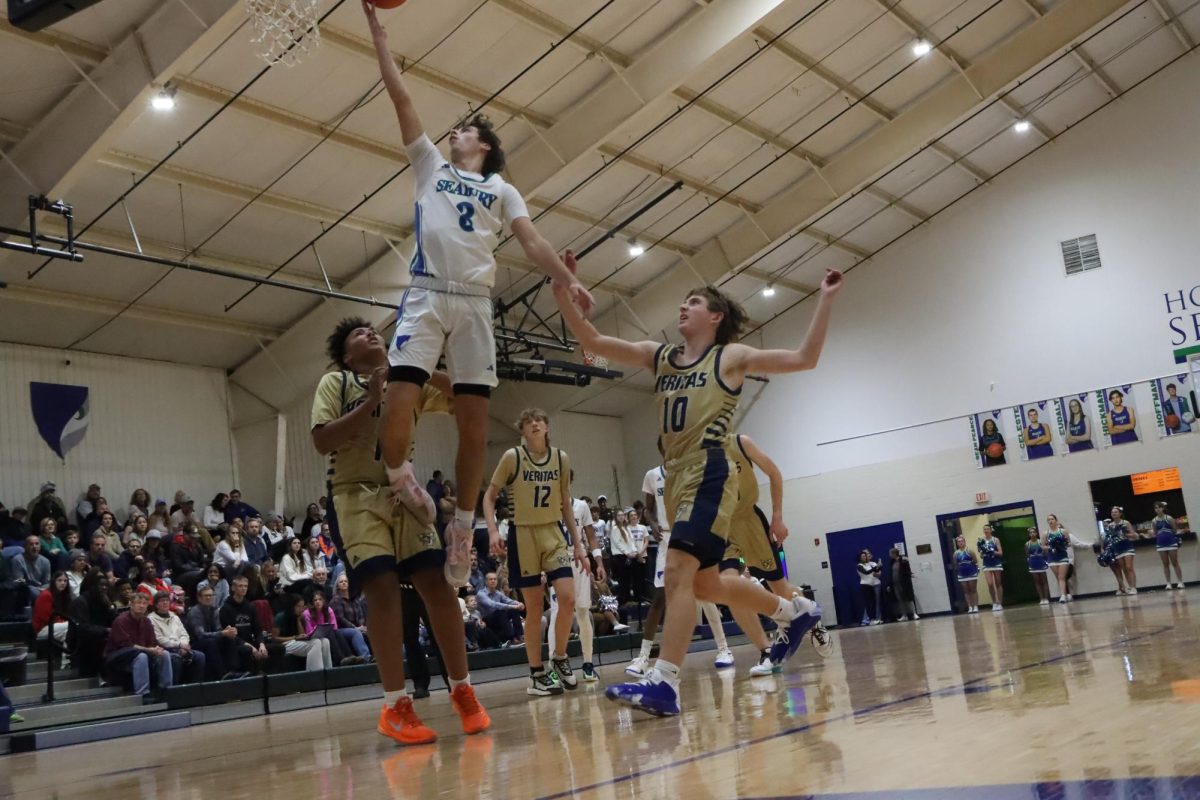
For every Kansas University, there is a Kansas State University. For every Chiefs, there is a Raiders. Rivalries are an integral part of how we ingest sports media. After all, who would go to a Raiders game unless they were playing the Chiefs? Without these fierce rivalries, sports simply would not attract so many constant viewers. But what are rivalries like on a smaller stage? What do Seabury’s rival schools bring to our sports programs?
First of all, who truly are Seabury’s rivals? Faculty member Brian Rios says, “Overall, I think our biggest rival would be Heritage Christian Academy, now that they’re in our conference. Veritas has always been one, but we don’t usually compare with them, just because we beat them so well in most sports that we play now. Heritage Christian is always a good competition.”
Some would even argue we have multiple rivals: “I would say our biggest rivals are, in order: Heritage Christian Academy first, then Maranatha Christian Academy and then Kansas City Christian Academy,” says junior Lucien Brockhoff.
A major part of what defines rivalries is the reason behind them, so how did Seabury acquire these rivalries? Brockhoff says, “Well, in the case of some of them, it’s because they’re as good as us, and it’s good competition, and good competition leads to high emotions.”
When asked about the differences between rivalry and normal games, junior Alice Pulsinelli says, “It gives us extra incentive to care … All the players really want to show up and show out for their school. And I think it’s just a really cool opportunity to take our play to the next level and really play for something in the game.”
Similarly, seventh grader Theo Beck says, “[Rivalry games are] a lot more spirited, a lot more physical.”
Seventh grader Zabi Borjas says, “There’s a lot more people, and it is very loud and more energetic than usual.”
When asked about how he and his teammates react to those games, Beck states, “We kind of know we have a chance to win, so we play a lot harder.”
Brockhoff says, “It’s definitely a lot easier to lose your temper because our rivals and us already know that we dislike each other, so it kind of becomes a self fulfilling prophecy. Any annoying thing that might happen throughout a game just means more because it’s against the rival.”
When asked about what he observes about the athletes during rivalry games, Rios notes, “I think they have a lot more grit and competition. They’re competitive, and same for us, right? Like, I think there’s a little bit of trash talking that happens sometimes on the court, but it’s all in good nature, because after the game, we can shake each other’s hands and say, ‘you know, at the end of the day, we’re doing the same thing. We’re playing for a better purpose, a bigger purpose.’”
When asked if rivalry games are more fun than normal games, Brockhoff says, “It’s a lot more fun to play rivalry games, because the energy is a lot higher. The drama is higher because the emotions are running hot. And, generally, we have a lot more school turnout, regardless of what sport it is. A lot more students show out and support our teams because they really care about beating whatever rival we’re playing.”
When asked about what the other teams bring to our rivalry games, Rios says, “It’s always a little bit more, I don’t know, a little more chirpy, a lot of more people talking on the court when we play them, just because there’s a little bit more pride at stake.”
When asked the same question, Brockhoff says, “The student sections of the schools who I consider to be our previous rivals are always packed out for the exact same reason that our student sections are packed out, because some of those students in the student sections have played our school and other sports.” Brockhoff elaborates further, saying, “They’re always excited to get a shot at us, because usually we win because we are better than our rivals. But it’s just [that] they’re really excited to get a chance to play in a high energy, high emotion, intense game.”
Rivalries are important not only to sports in general, but to Seabury culture. Our rivalries are a large part of our values as a school. So we should all do our part to cheer on our Seahawks in their rivalry games.