From recycling to lunch cleanup to setting up chair after chair, student jobs are a unique piece of the Seabury community. While they may elicit daily groans, our student body’s identity is shaped by stepping up and helping out.
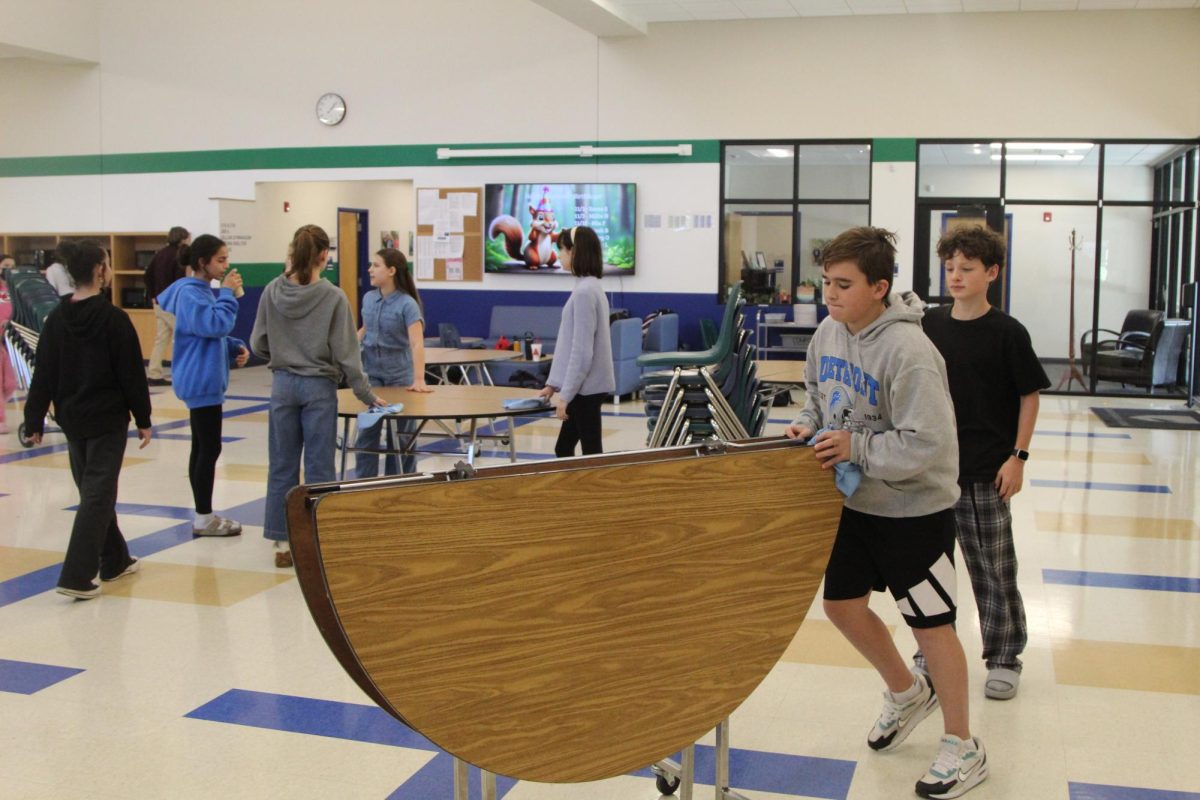
Seventh grader Brogan Dasenbrock, a first-year Seahawk, finds appreciation within his grade’s task of cleaning tables: “I really like how each student just rushes to get the spray [bottles], and it’s really satisfying to clean all the tables and then put them [away], and it’s really good teamwork. My least favorite thing about it is that there’s only four [spray bottles], but that’s really it, honestly,” he says.
While seniors earn a break after up to six years of student jobs, they can still recall their experiences, both good and bad. Senior Owen Koederitz reflects on his student job experience, saying, “I think my favorite part about doing student jobs, if I could say this is a favorite part, is probably just the fact that you’re helping out to help out with the community, and that’s always nice to help other people out by participating with your grade … and then my least favorite part … would be eighth grade; cleaning microwaves is the worst, no offense. Props to the eighth graders out there; it sucks.”
While there is certainly truth to Koederitz’s words, Seahawks are still able to find satisfaction and even amusement in their work. Sixth grader Meral Al Hashimi remembers funny experiences doing recycling: “[One time], it was raining, so we had to run, and that was fun. And then one time, me and Marie got locked out for like five minutes, but it was okay,” she says.
Eighth grader Rand Ababneh also shares a humorous story, saying, “So in seventh grade … one day we ran out of spray, so we just didn’t spray the tables, and [Mr.] Whipple always yells at us about it, but this day, [he] decided to say nothing. And then the next day, I was sitting at my table, and there was a big spot of spaghetti just sitting there, and it dried up, and there was just a big glob.”
Similarly, Koederitz says, “In tenth grade when we would set up chairs, our first few times we weren’t really good at it, so we kept putting the chairs really close together, so no one had any leg room, and then everyone was complaining about it. That was kind of funny.”
Aside from the work itself, students recognize the importance of student jobs in enhancing Seabury’s community. For junior Vee Asher, the jobs are “about having community and knowing that if you need to get a job done, that your peers will be there to help you. Just working as a grade, working as a group to get a task done, I feel like that’s not just relevant in school life, but it’s also relevant in the real world. So I think it’s a really valuable thing that we practice,” she says.
Dean of Students William Whipple adds a faculty perspective, saying, “What it means to be part of a community is that you show up and you participate. In terms of [Seabury’s] values, I think service leadership is a big part of that, and giving back to the community and being a part of its cleanliness and its organization has an impact, not just on individual character development, but also on your feeling of connectedness to the school and to each other.”
While active participation is undoubtedly important, Ababneh points out that willingness to let others step up is equally so: “It just helps us all become better [when we all participate], because it’s not only the people who already have that mindset, but helping other people make that mindset … Not doing too much [is important], letting other people take a chance to participate if you’re a person who likes to do extra,” she says.
Students agree that despite their gross or inconvenient moments, student jobs offer life skills that reach well beyond the classroom. Dasenbrock believes that “they can help [with] teamwork; they can help [with] being able to talk to people and communicating … You can develop being nice and being able to tell someone to do something without being mean, but just be able to communicate and be nice.”
Whipple adds that he hopes student jobs will leave Seahawks with “a sense of duty and commitment to community. I think that we all have a role to play; sometimes those are assigned and sometimes they’re not, but I think realizing that no matter where you are, here or anywhere else, you have a role, and you can make things better by chipping in.”